
In middle school and high school, I took Spanish. I loved it in middle school and took a class trip to Spain with my teacher, Madame Tessier, whom I adored. In high school, I hit my funk for schooling. I became a poor student, intentionally, for countless illogical reasons which swam around in my adolescent brain as I struggled for social acceptance. Ms. Dix, an excellent teacher, was baffled. So was my Latin teacher mother. After two years of high school Spanish at a C+ level I switched to Latin. I was starting to take school seriously again by the end of 10th grade and maybe, subconsciously, wanted to make my mom happy by showing an interest in a subject she taught and loved. Freudians… start your engines, but I digress. I was an only-average Latin student (though I can remember that an agricola is a farmer and two of them are agricolae) and, to my mother’s horror, as she helped me cram for my final exam in my second year, this “nationally recognized” “Latin scholar” squeaked by year two with a B. These ups and downs in my language learning which can be charted inversely with my teenage emotional maturity did do one thing: they fueled an interest in foreign language and a relatively fearless approach to just giving it a go.
On our first trip to Europe together, in France, I proudly hauled around my “French for Dummies” book rehearsing phrases and trying my best with sometimes helpful (and sometimes not) serveurs and réceptionnistes des hôtels to slog my way through and butcher their language but doing my best.
About a decade later, we landed in Portugal on a hot late summer day. Phrase book in hand and a few dozen hours of last-minute Rosetta Stone under my belt, I, foolishly, thought my Spanish would help (it kind of does with reading but not much else). But then, on that trip, everyone we encountered spoke English. Granted, we were in touristic areas in hotels, restaurants and Airbnbs, mostly. We visited big cities like Lisbon and Porto, smaller ones with large universities like Coimbra and Évora. Even the smaller towns we visited have a good tourist population: Sintra, Douro Valley, Tomar and Cascais. Most of the people with whom we interacted worked in the tourism or service industries. We thought, as we decided to take a leap and make Cascais our European home, that we wouldn’t need to know much Portuguese and, though we wanted to learn it if we moved here, it wasn’t urgent. Our non-English speaking realtor should have been a tip that we were mistaken.
After two months of getting moved in just before COVID struck us all down, we realized that we needed to study Portuguese for real. We could get by with English, but life would be much easier if we could communicate in Portuguese. At the mall, they could usually find a store clerk who spoke English but most of the people we needed to call for apartment issues (electricians, plumbers, etc.) did not speak any. To get by, and to be able to fully communicate and embrace the culture and its people we needed to learn.
I hit Duolingo in February of 2020 (still use it daily). Then found out that both Rosetta Stone and Duolingo are Brazilian Portuguese (wait, what? There’s more than one? Yes, sports fans, there sure is, in dialect, accent, pronunciation and even some words), not the European version. This next sentence is controversial with Brazilian and European Portuguese speakers alike: it does help (just don’t say so on any Portuguese expat Facebook group unless you want to get skewered seven ways to Sunday for how stupid you are). It can help you build vocabulary and learn/reinforce what you might know about conjugation of verbs just like my Spanish helps with verb conjugation, some vocabulary and unraveling the mysteries of why a bottle (garrafa) is female and a car (carro) is male. It (Brazilian Portuguese) can also hurt you. For example, if you only learn Portuguese through Duolingo you’ll be wandering around the streets of Lisbon complimenting people on how cute that hot dog is that they are walking. And, Duolingo will absolutely not help you with hearing European Portuguese or with speaking/pronouncing it.
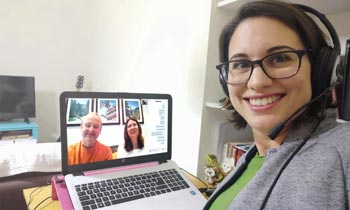
We enrolled in Portuguese lessons online, from the U.S., during COVID and have had some amazing teachers with the Portuguese Connection. We began with Lydie (the image on the top of this post is a photo she took for their website four years ago of us doing a lesson with her), whose welcoming smile made the early days of learning colors, accents, the rules of Ser vs Estar and how to sing the alphabet song (much more fun than the English ABC’s song: “todos juntos, cantamos o alfabeto, oh yeah, oh yeah, oh yeah”). After Lydie, we began lessons with Isabel with whom we still take lessons four years later. Isabel is perhaps the best teacher we’ve ever had in all of our schooling. She’s become, and we hope she feels the same way, a friend.
Our learning has been filled with ups and downs. Thrills of victory, like the day we were able to get Portuguese NOS eSIM cards installed on our US phones (a relatively new innovation at the time) with a lovely young woman at the NOS store in Cascais using only Portuguese, as she spoke zero English, three years ago, have been dotted with agonies of defeat, like, even now, trying to watch the morning news without the words below for context. But, overall, we have progressed and, while nowhere near fluent, we can communicate and handle most things without English (we still use mostly English with our doctors, that’s one area where shades of cinzento are mau, in our opinion).
Yesterday, we took the CIPLE test so that we could eventually apply for a Portuguese passport. This is the biggest requirement, outside of those rules you need to follow required by your visa, in order to obtain dual citizenship and avoid costly and bureaucratic visa renewals every few years. It was, in one word: brutal. On the “agonies of defeat” scale it was top. The reading and writing sections were fine, we both feel we did these with around 85-95% proficiency. The audios section was almost comically impossible. It is notoriously difficult by reputation. Not only from a content perspective, but it is also made difficult by the added stress you experience from doing the real thing, poor acoustics in a vacuous classroom and a poor AV system coupled with distractions from other students, proctors and hallway noise. This one was way harder than the ones on the practice tests we did (about 10 of them as we prepped) issued by the organization that administers the CIPLE (or created by our instructor to mimic the real tests), including the one on the official website that you should use as practice when you sign up to take the test. Like, probably 5x harder. As a point of comparison, we think we got about 25% (without benefit of an answer key) compared to at least 55-60% average on the practice tests. Even the fluent Portuguese speaker in our test group who had spoken Portuguese since childhood found them tricky, filled with nuance, and difficult. The test isn’t supposed to test fluency, at least not as advertised, and our teacher, Isabel concurred that it sounded harder than normal. It is supposed to test to the A2 level of proficiency (A1, A2, B1, B2… etc. are the levels as you ascend in learning). Maybe there’s been some change to the test, but we felt woefully inept. Especially compared to what we’ve read online about how hard it should be and how we were feeling going in after each scoring about 80%+ (in total) on our final practice test with Isabel the day before. The whole group of candidates seemed to feel the same way. So much so that about a third of the people bailed out after the audios and didn’t even stick around for the last section, which was the hard-to-prep-for and hard-to-predict interview.
But.
While we were initially defeated, demoralized, exhausted and anguished over it, we awoke this morning with new resolve. To get better, to do what it takes to get this certification be it through a retry in the coming years or more intensive classes. And, of course, there’s a chance we passed. You need 55% to pass (which, frankly, seems like poor test design, people) and we may have squeaked through though we now have to wait for a hysterically long six weeks to find out.
Regardless of the result, this learning Portuguese has been an amazing experience. We’ve met lovely people, we’ve learned how to adapt and deal with situations with our Portuguese, and we do communicate almost entirely in Portuguese in shops or at the mall, or at the hospital (clerical staff and nurses, not doctors), with contractors (many more than we expected to need when we bought what we thought was a “lock and leave” apartment but that’s for another post), in hotels or restaurants, etc. We love it and it’s been good for our fifty-something year old brains to challenge ourselves and learn something new. We are frequently told we speak very good Portuguese, which may just be the typical Portuguese friendliness, but I am not so sure. I do think we do pretty well. Melissa said last night that no matter our test scores “we did something really hard today”, we put ourselves out there and we tried. I think Ms. Dix and my mom would be proud of us. Pass or fail, we sure are.
Editor’s update: in the end, we both passed and are so excited! I’ve never felt so happy to be adequate.


 The Traveling Ridleys: Sunday Journal
Leave a comment